Why Donor Qualification Is Key to Fundraising Success


Every organization seeks new donors to grow. However, strengthening relationships with prospective high-value supporters takes time, which is why nonprofits need to focus on donor qualification to narrow down their top prospects.
Donor qualification may seem simple on the surface but can quickly become complicated, especially if a nonprofit lacks the necessary capacity to qualify donors at scale. To ease this process, we’ll cover tips to help you better integrate donor qualification into your moves management strategy:
- Donor Qualification FAQ
- 3 Steps to Incorporate Donor Qualification Into Moves Management
- How to Think About Donor Qualification
Donor qualification can help elevate your donor stewardship and improve your moves management process as you get to know donors better.
Donor Qualification FAQ
What is donor qualification?
Donor qualification is the process by which you determine whether or not a donor is someone you should spend time building a personal relationship with. While you likely already determine whether prospective donors meet your major gift criteria through prospect research, donor qualification helps you identify donors who not only meet your criteria but are also interested in building a personal connection and relationship with your organization.
Donor qualification also helps you focus on supporters who are likely to develop an impactful relationship with your nonprofit, preserving your limited time and resources while boosting overall development return on investment (ROI).
How does donor qualification work?
Donor qualification typically involves holding personal, one-on-one conversations with donors to learn about them and develop your relationship. Usually, the major gift officer will lead the conversation, asking questions and getting to know the donor better.
Rather than aiming to cinch a major gift by the end of each conversation, donor qualification meetings are small steps taken over time that build genuine relationships with donors. They should not be rushed or transactional.
When should you perform donor qualification?
You should perform donor qualification before soliciting major gifts, but ideally, it will be a standard part of how you interact with current and prospective donors. Because donor qualification involves developing relationships with donors, it is not a one-and-done task. As a result, we recommend implementing donor qualification as part of your ongoing moves management process.
What is moves management, and why is it relevant to donor qualification?
Moves management refers to how nonprofits handle the individual steps, or “moves,” in the donor engagement process. It involves outlining goals for each move and determining the next actions your team should take. This process helps you better identify the right moment to make an ask.
Because donor qualification is an essential part of the donor engagement cycle, you should incorporate it into your moves management process. However, rather than making it its own step, it’s more beneficial to infuse donor qualification into all of your steps. When fully integrated into your moves management process, the ongoing conversations involved in donor qualification help you continuously learn more about donors, improve engagement, and build authentic relationships over time.
3 Steps to Incorporate Donor Qualification Into Moves Management
Many development officers think that qualification is the first thing you must accomplish with a prospective donor. While it is the first step to a positive donor relationship, it’s not the only time a prospect or donor should be qualified.
One way to positively embrace qualification is to make it part of every step of your moves management process. If it’s not, you’re not learning or asking questions, and you may miss opportunities with your donors. After all, the ultimate goal of qualification is to determine whether or not a donor wants to move forward in their relationship with your nonprofit, which is invaluable information to know at every stage of moves management.
Follow these tips to incorporate qualification into all stages of the moves management cycle—not just at its start.
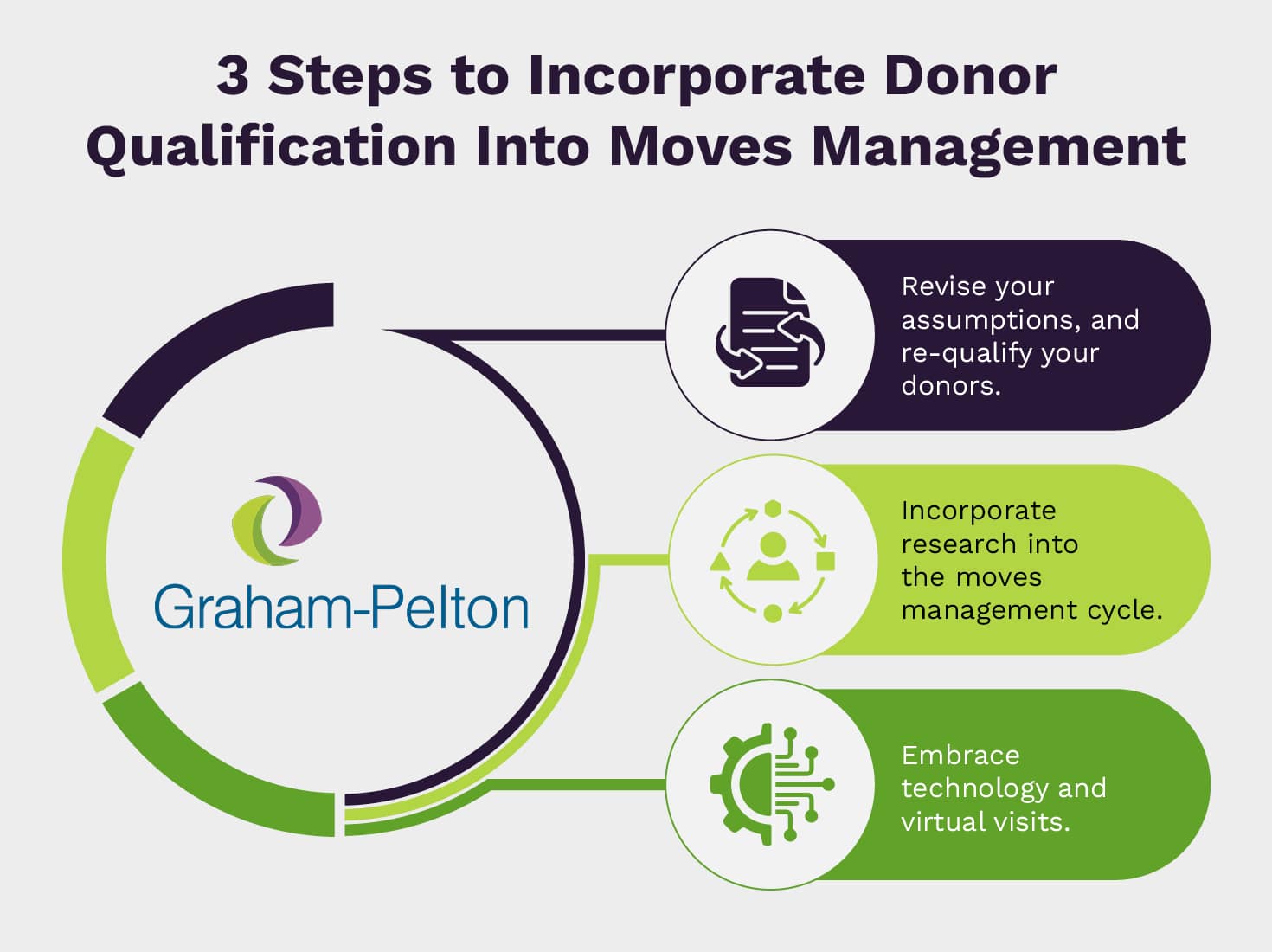
1. Revise Your Assumptions and Re-qualify Your Donors.
People’s lives, interests, and priorities are constantly changing. That’s why you need to re-qualify your donors regularly.
Every conversation should have a goal, and as a development professional, you should learn something new after every conversation. Your qualification questions should look and feel different during this stewardship period than they did when you first identified the donor. For example, you may ask questions like:
- Are you aware of our new programming?
- Is there a program we offer that you’d like to learn more about?
- You’ve been supporting [Program Name] for several years now. Why are you passionate about that particular program?
- Has your motivation for supporting us changed at all over the years?
- Aside from your generous financial support, are there other ways you’d be interested in getting involved with our organization?
Remember, you are qualifying the prospect for the next phase in the development relationship. For a prospect in stewardship, you might be qualifying them for the next gift or for a different type of gift, like planned giving.
2. Incorporate Research into the Moves Management Cycle.
Don’t just complete research in advance of a solicitation. There are easy steps anyone can take to complete 10-minute qualification research before your first meeting. Don’t rely on your team’s prospect researcher to handle this work alone. Major gift and development officers can also contribute to this process.
Here are three examples of data points you can source on your own:
- Where do they work? Has the business they worked for been doing well in the last year?
- Do they hold any stock? Have they recently sold stock or bought new stock?
- Do they sit on any boards? It is often easy to determine if they’re connected to other nonprofits or companies.
As you approach a planned solicitation, that may be the time to complete a more comprehensive profile. After you’ve been in contact with a donor for 12-18 months, it’s time to revisit the qualification research you did initially, asking questions like:
- Have they made new gifts?
- Did they buy and sell stock?
- Have they moved?
Research can help you validate your assumptions, and it can also provide important data points you may not obtain in a casual conversation. Wealth screening tools such as iWave, DonorSearch, Blackbaud’s ResearchPoint, and WealthEngine can help expedite the process. Leverage these as well as your own research to create as comprehensive donor profiles as possible.
3. Embrace Technology and Virtual Visits.
While it can be helpful to meet with donors in person whenever possible, some supporters may not be able to show up to your headquarters. Remain flexible throughout the moves management process by arranging virtual visits.
Not only do virtual visits offer added convenience for supporters who live far away, work full time, have children, or are otherwise physically unable to attend these meetings in person, but they also offer a unique opportunity to talk to donors without worrying about note-taking. By leveraging virtual note-taking tools, you can let the technology do the heavy lifting, allowing you to stay present and focused during the conversation.
How to Think About Donor Qualification
Many people, especially early in their careers, view qualification as unnecessary. Yet, your perspective may change dramatically when you view it through a new lens:
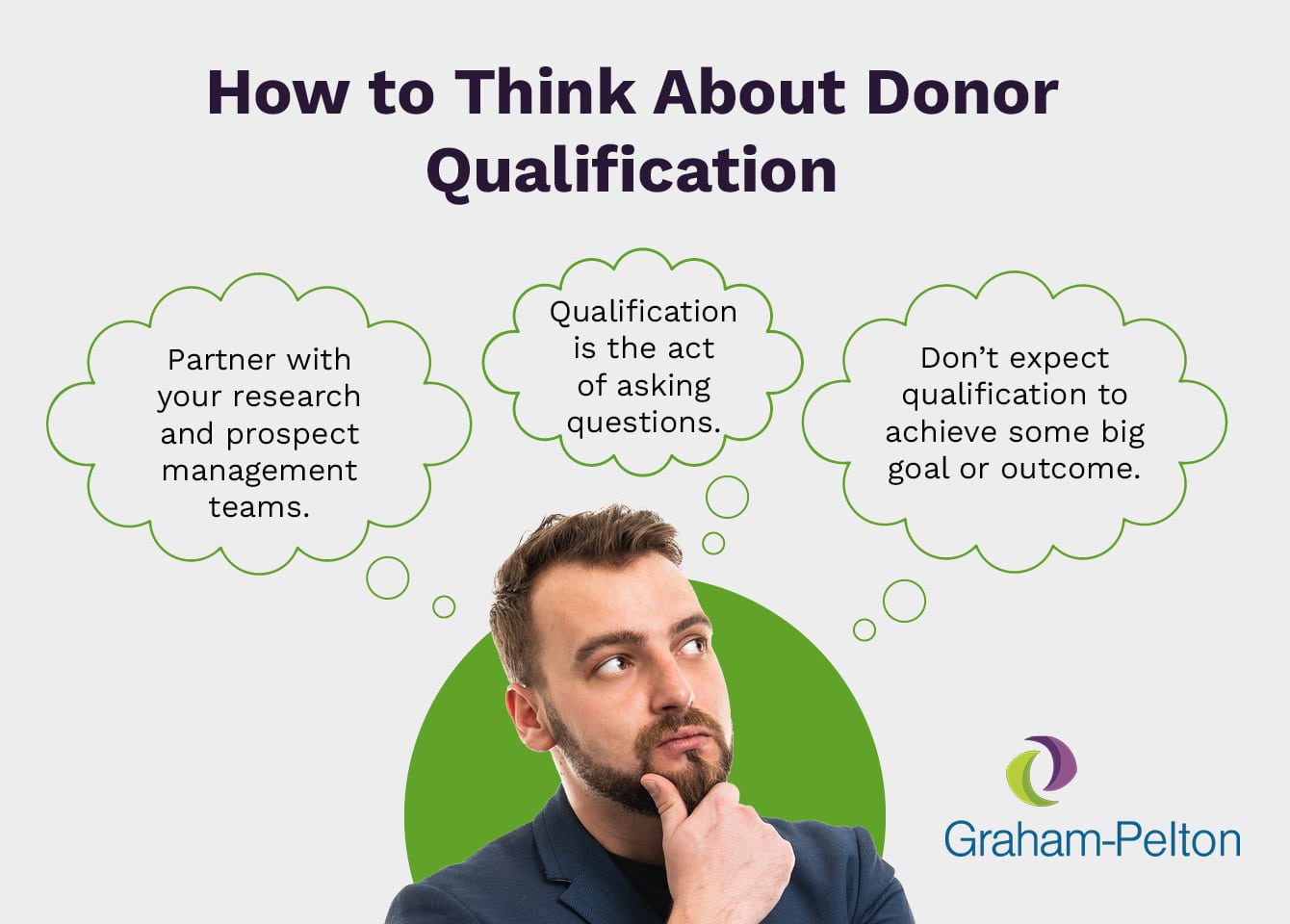
- First, qualification is the act of asking questions. Not only is it easier to incorporate qualification into your own portfolio management, but also to reframe the task for leadership, board members, and colleagues.
- Second, don’t expect qualification to achieve some big goal or outcome. Instead, think of it as the small steps you take that, over time, result in a long journey.
- Third, partner with your research and prospect management teams. Remember that the onus is not just on your researcher to find new prospects or qualify donors. Just like qualification, your relationship with your research colleagues should be consistent and ongoing.
Wrapping Up
As you move donors through your cultivation and stewardship cycle, getting to know them through donor qualification is essential for increasing donor affinity for your organization. These relationships not only genuinely improve your nonprofit’s donor relationships and reputation but also increase your chances of securing major gifts from donors who feel connected.
Remember, qualification should be an ongoing process that’s integrated into your broader moves management strategy. The value of continually learning more about your prospects and donors as individuals can’t be understated.
To learn more about nonprofit development best practices, explore these additional resources from the Graham-Pelton team:
- Your Guide to Mastering Predictive Analytics for Fundraising. Explore how to incorporate predictive analytics into your donor qualification process to learn even more about donors and prospects.
- How to Write a Case for Support: Pro Tips for Driving Impact. Every nonprofit can benefit from developing a compelling case for support for general or campaign-specific use.
- Grateful Patient Fundraising Essentials: Gratitude to Impact. Donor qualification is just one of the best practices to keep in mind if you’re fundraising for a hospital or similar institution.