A Practical Guide to Independent School Fundraising


While tuition may cover many of your school’s expenses, private and independent school development teams understand the importance of fundraising. Fundraisers help fill the gaps in your school’s budget, ensuring you can continue providing your students with the high-quality education and school experience they deserve.
To help you plan your next campaign, this how-to guide for independent schools will walk you through the essential steps for a successful fundraiser.

1. Determine your goal and purpose.
Ahead of your fundraiser, determine how much money your school needs to raise and why. Setting tangible goals will keep your team on the same page, keep each fundraiser focused, and provide a concrete reason for why donors should give.
To set a reasonable goal, first assess your current fundraising strategies, past campaigns, and overall finances. Ask yourself:
- How much do we earn through fundraising in an average year? How much did we earn last year?
- What is our fundraising budget? Would our board be open to increasing it?
- How much do our programs cost? Are there any notable financial shortfalls or limitations?
- What are our current fundraising sources? If we were to lose one of these sources, would our school still be able to function?
- Do we foresee any immediate fundraising opportunities or challenges?
Use your answers to guide your goals. For example, if you have a building that needs renovations, you would likely launch a capital campaign to fund the construction project. Conversely, if you know you are going to receive a major donation in the near future, you might run a short-term campaign to take advantage of the multiplier effect, wherein a large gift inspires other donors to give.
Many independent schools will identify several purposes during this process, each with its own goal. To address several needs, your school will need to run multiple fundraisers, seek out unrestricted gifts, and consider how it will distribute annual gifts.
2. Assemble your fundraising team.
The size of your fundraising team will depend on the size of your school. Some independent schools have just one person, whereas large institutions have multiple teams.
To accommodate for differences like these, rather than listing roles, here are the core skills your fundraising team should have:
- Donor management and stewardship. The better you can keep track of your donors and build relationships with them, the more supporters you’ll have. Use a donor database to maintain records on all of your supporters, enabling you to manage relationships at scale.
- Donation solicitation. Actually making the fundraising ask is often one of the most difficult aspects of fundraising. Ensure your team has someone who is comfortable soliciting donors, pitching your school, and navigating conversations about funding.
- Marketing. Maintain relationships by keeping in touch with your school’s community through marketing campaigns. While you don’t need to be an expert in every communication channel, your team should at least be capable of making strong marketing content and using communication platforms like email, SMS, and your school’s website.
- Project planning and organization. To keep your fundraisers and team members on track, ensure you have someone with project management and organizational skills. For larger schools, this will be the head of the fundraising team, and they will also be responsible for keeping everyone accountable for their specific tasks.
- Data analysis. Your independent school likely has extensive donor data. By analyzing this information, you can plan successful fundraisers and even identify prospective major donors through prospect research.
If you are currently lacking a team member for any of these core roles, consider either expanding your team or working with a consultant. Fundraising consultants, like Graham-Pelton, can train your team, implement strategies to improve fundraising, or even complete core tasks for you, like data analytics.

3. Choose fundraising ideas.
To raise funds, you need strategies and ideas that will inspire your donor community. Consider your donors’ motivations, what types of fundraisers they’ve responded positively to in the past, and current fundraising trends that similar schools are finding success with.
Independent schools typically run several fundraising programs at once. Most fall into four categories:
- Long-running campaigns span multiple years and fund major priorities. Examples include capital campaigns for new facilities, endowment campaigns for financial aid, and comprehensive campaigns that combine several goals.
- The annual fund raises unrestricted dollars each year from parents, alumni, faculty, trustees, and friends to support day-to-day operations. For most independent schools, it is the foundation of the advancement program, and it typically continues alongside a capital campaign.
- Events such as galas, reunions, giving days, and silent auctions build community and raise funds in a short window. Their greatest value is often cultivation: introducing your team to prospective donors and deepening existing relationships.
- Ongoing advancement consists of strategies meant to build out your school’s overall fundraising capacity. These include major gift cultivation, planned giving programs, and newer gift types like grants from donor-advised funds (DAFs).
To keep your school financially healthy, you will likely pursue ideas from each of these categories. For example, your school may focus much of its energy on a capital campaign while continuing to grow its annual fund and hosting signature events that keep families and alumni engaged.
When selecting fundraising ideas, consider how you can diversify or experiment with new fundraising methods. For example, maybe your school wants to explore accepting stock gifts, or perhaps you want to try moving your regular auctions online. While not every idea will be a hit or produce immediate results, the more revenue channels your school has, the more stable your funding will be.
4. Create a fundraising calendar.
To manage your multiple ongoing campaigns, create a fundraising calendar at the start of the year. Add notable dates and create separate calendars for individual projects where you can add every small task.
For example, many nonprofit organizations, including independent schools, will maintain a separate calendar specifically for managing outreach, like social media. Your annual fundraising calendar might have a note that marketing for your fall festival begins on September 30th. Then, your marketing calendar states exactly what messages will go out on that date, a reminder to send follow-up messages the following week, and dates for coordinating your social media blasts.
For long-running campaigns, add their beginning and end dates, as well as any notable events. For example, a capital campaign might have dates marked for the beginning of its feasibility study, its public phase kick-off, and its official deadline.

5. Be strategic about your budget.
Fundraising professionals know you have to spend money to make money, but doing so can be tricky when you’re on a tight budget. When planning your fundraisers, keep track of your expenses, consider each fundraiser’s potential return on investment, and work to find cost-saving opportunities.
Here are a few ways your school can be budget-conscious:
- Save decorations for annual events to use again.
- Work with your parents’ association to recruit volunteers for recurring events.
- Explore low-cost software or even platforms with month-to-month contracts so you can cancel or pause during the summer.
- Rent out your gym, cafeteria, or other large spaces during the summer or holiday seasons to earn extra revenue.
- Keep a close eye on your books to ensure all transactions are properly recorded, and you can adjust your strategy as needed to stay on budget.
With all of this in mind, don’t be afraid to make investments. Working with a consultant and purchasing fundraising software can pay for themselves while setting your school up for more successful fundraisers.
6. Build a major donor pipeline.
According to CASE Insights 2025 report on Philanthropy in Independent Schools, gifts of $25,000 or more made up 78% of funds received and came from just 2.9% of donors. This means that if your independent school isn’t already working to connect with major donors, it may be time to make that a top priority.
A major donor pipeline ensures your school is routinely sourcing new major donors, reaching out to them, and moving them toward their next gift. A few tips for building this system include:
- Data collection and hand-offs. Standardize what information your team gathers, how they log interactions, and how they hand off prospects. For example, you might create protocols for how and what type of information your event team should share with your development team.
- Regular research. Major donor programs require extensive research, including regularly screening your donor database for potential major donors, as well as qualifying new prospects.
- Consistent stewardship. Earning a major gift is a long-term process, and your school should be ready to steward prospective donors for months before they commit to a gift. Ensure your development team logs every interaction they have with major giving candidates in your donor database to keep the engagement moving forward and prevent any prospects from going cold.
A dedicated process and documentation also help your school maintain donor relationships even when team members depart for other opportunities. While major gift officers cultivate personal connections, each donor’s records and where they were in their giving journey should help a new team member continue the relationship.
7. Collaborate with your community.
Gain more support and get more hands on deck to help out with your fundraisers by reaching out to your school’s greater community. A few key groups to connect with include:
- Students and their families. Schools have a key fundraising advantage: their students. Students, especially older students in middle and upper schools, can be effective participants in fundraisers. Students might run booths at your school carnival, check in guests at a gala, or fundraise on your behalf during a peer-to-peer campaign.
- Local businesses and community organizations. Businesses often sponsor schools, providing cash donations or free or reduced services in exchange for promotion. For example, at a football game, you might add the logos of businesses that supported your team to banners around the field or stands.
- Alumni. Former students likely still have an attachment to your school and will want to see it succeed. Plus, since alumni are familiar with the student experience, they can serve as ambassadors for your school by sharing memories from their time as students.
- Trustees. Your board of trustees sets the tone for giving across your school community. According to the same CASE report, trustee gifts made up a median of 7.7% of funds received in 2025, and median trustee participation was 90.2%. Invite trustees to make their own gifts early, host cultivation events, and introduce your development team to people in their networks.
Along with gaining volunteer support, collaborations also solidify your connection with your community. For example, parents who see all the effort your school puts into fundraisers are more likely to donate.
8. Analyze your metrics.
When you learn from past fundraisers, you can ensure each campaign is more successful than the last. Specifically, pay attention to metrics like:
- Donor retention
- Average gift size
- Total number of donors
- Total number of major donors
- Donation frequency
- Event attendance
- Outreach responses
With this data, you can conduct predictive analytics to make data-backed decisions about future fundraisers. For example, you might be able to forecast how much your next peer-to-peer campaign is likely to earn based on historical data, letting you budget more effectively.
To interpret your data and gain in-depth insights, consider working with a fundraising consultant, like Graham-Pelton.
Graham-Pelton: Your Independent School’s Fundraising Consultant
Our team at Graham-Pelton has extensive experience working with independent schools, including boarding, day, co-ed, single-sex, and international schools. Whether your independent school has a long-established development program or is building one for the first time, we’re committed to helping you develop a culture of philanthropy that leads to successful fundraisers.
For example, we partnered with St. Benedict’s Prep in Newark, New Jersey, on a campaign that exceeded its $100 million goal.
By partnering with Graham-Pelton, your independent school can access services like:
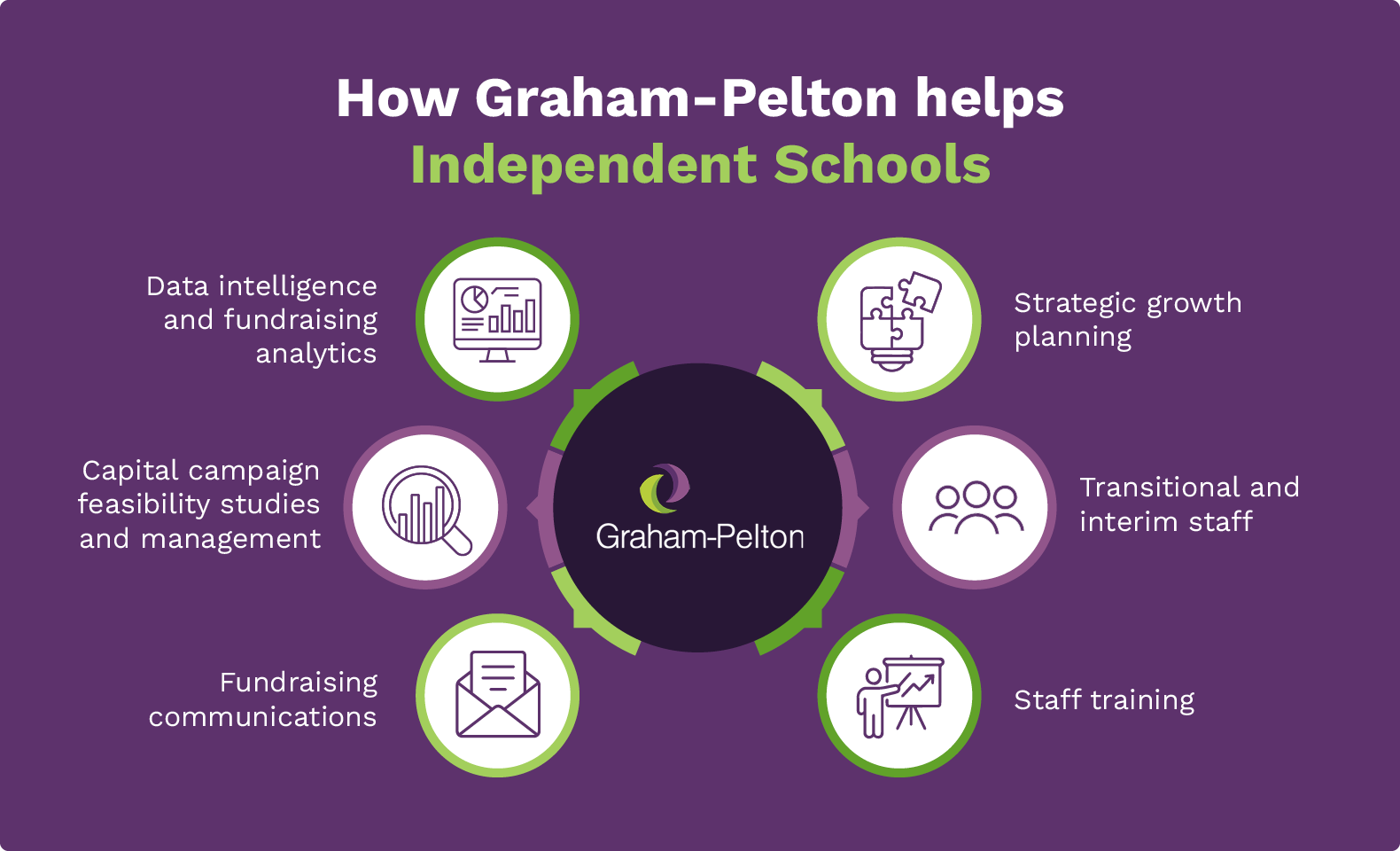
- Fundraising communications
- Capital campaign feasibility studies and campaign management
- Data intelligence and fundraising analytics
- Strategic growth planning
- Transitional and interim staff
- Staff, board, and leadership training
With support from Graham-Pelton, you can implement all of the strategies in this guide to craft a practical fundraising strategy, just for your school.
More Fundraising Resources
Independent school fundraisers require expert resource management, data-backed strategies, and an ability to juggle multiple campaigns at once. If your school needs help with its fundraisers, turn to an experienced consultant, like Graham-Pelton.
For more fundraising resources, explore these top guides:
- How to Write a Case for Support: Pro Tips for Driving Impact. If your school is planning a major campaign, an effective case for support is essential. Discover how to write an inspiring case for support.
- Should You Hire a Capital Campaign Consultant? Quick Guide. Capital consultants are key for any independent school considering a capital campaign. Learn what to look for when assessing consultants.
- 9 Key Types of Planned Gifts, How They Work, and Examples. Planned gifts can provide independent schools reliable funding. Explore how to launch a planned gift program or get tips for improving your current one.