Donor Motivations: Questions to Ask and Assumptions to Avoid


“Why do you support our organization?” This seems like a simple question for donors, but it often goes unasked.
Even the most experienced fundraising professionals can run into the trap of assuming they already know the why behind their donors’ behavior. Donors are unique individuals who are influenced by multiple factors when deciding how, when, and why to be charitable. For instance, you might assume donors give because they care about your mission, but remember that they also care about their personal missions.
Therefore, instead of assuming you already know the ins and outs of your donors’ motivations, it is important to ask, “What other motivating factors might be at play?”
To help you answer this question and better understand donor motivations, this guide will cover:
- How to Discuss Donor Motivations
- How to Recognize and Eliminate Assumptions
- 5 Questions to Uncover Donor Motivations
- 4 Common Donor Motivations for Charitable Giving
Having a secure grasp on what motivates your donors can help you build stronger cases for support, develop tailored stewardship strategies, and solidify valuable supporter relationships.
How to Discuss Donor Motivations
While it’s critical to have a strong understanding of donors’ demographics, contact information, and giving history, a comprehensive donor profile should also include known philanthropy to other organizations, any indications of philanthropic motivation, and what challenges they believe philanthropy can solve.
Questions about donor motivation, asked and documented at any stage of the donor relationship, provide essential insights into the donor’s mindset and their history of charitable giving.
As you think about engaging each prospect, ask yourself:
- Has a relationship with our nonprofit been established? Consider where a donor is in their journey with your organization and how their current stage might impact their motivations. Additionally, your history with a donor should inform how you discuss their motivations. If a donor is brand new, it’s fairly common practice to ask them how they first heard about your organization. If a donor has been with your nonprofit for some time, you will likely instead have a personal enough relationship to have a more in-depth conversation about their motivations.
- What don’t we know about our donor? Your donor profile is a collection of everything you know about each prospect. Take a second to consider what is absent from the profile, thinking beyond empty entry fields. Do you know if a donor has a personal connection to your cause? Do you know the specific motivations behind their last gift? This assessment should focus on identifying any assumptions you have about a donor’s motivations and discarding them.
- What’s critical to understand? You don’t need to know every last detail about a donor to build a productive relationship with them. When thinking about motivations, consider how they relate to a donor’s giving capacity and affinity. If a detail is irrelevant to both of these factors, it is likely unimportant.
Information about motivations can be gathered in typical donor meetings, in small groups, or at events. Empower your Executive Director or Board Chair to uncover new information when they meet with donor prospects.
How to Recognize and Eliminate Assumptions
We recognize that at your nonprofit, no one has better insight into donors’ motivations than the frontline fundraisers they interact with regularly. Consultants can spot industry trends and recognize patterns across clients, but a frontline fundraiser who interacts directly with a donor has an inherently deeper understanding of that person.
If that’s the case, then what is so wrong with making assumptions?
The answer is simple: knowing a donor does not mean that every assumption about them is correct. So why do fundraisers make assumptions about donor behavior?
A brief investigation into the psychology of assumptions yielded an interesting answer: the “false consensus effect.” The false consensus effect refers to the tendency to overestimate the extent to which other people share our attitudes, beliefs, and behaviors
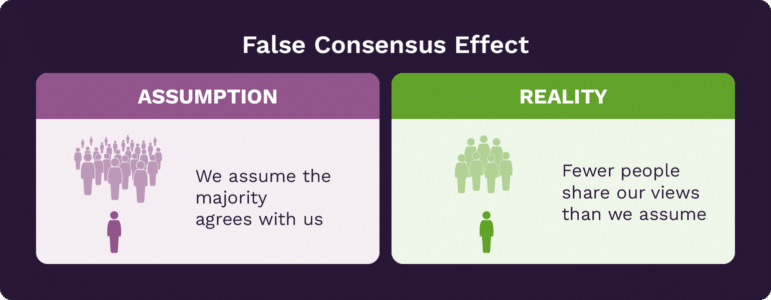
For example, if you have worries about the current economy, you might assume that your donors do as well. If you learned that a donor is undergoing a significant life event, such as a cross-country move, a health scare, or a change of employment, you might assume that their plate is too full to bother with philanthropy because, in their shoes, you would not have time for it. While it is wise to be respectful of our donors’ personal situations, you cannot know with any certainty how various circumstances will impact behavior unless you ask.
How to Move Past Assumption to Knowledge
When it comes to working with donors, personalization is everything. The most successful cultivation strategies are tailored to meet donors’ needs and help achieve their philanthropic goals. But how do you avoid the false consensus effect and move from assumption to knowledge?
Try asking yourself these five questions to move donor relationships forward with certainty rather than guesswork:
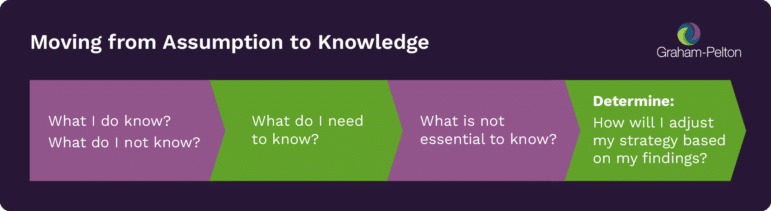
- What do I know? Consider what the donor has told you directly and what empirical data is available from reputable sources. For instance, imagine you are researching your donor and learn through a national newspaper that their small software company was recently acquired by a large tech firm.
- What don’t I know? Avoid taking any information you hear second-hand as an absolute fact. For example, you might hear from a mutual acquaintance that a donor had a financial windfall related to a business deal. This could be true, but unless you have documentation (SEC data, for example) to prove it, you do not truly know and should not base future donor interactions on it.
- What do I need to know to plan future stewardship? You will gather a lot of information about your donors, but not all of it will be directly relevant to their relationship with your nonprofit. For instance, if you heard a rumor that the donor had been laid off, you would need to confirm it, as that information directly impacts the donor’s giving capacity.
- What is less essential to know? What information is available but not actually necessary? For example, you might see a photo of your donor at a political rally for a candidate who subsequently lost. From this information, there is not enough evidence to confirm that this series of events would lead the donor to halt their philanthropy. It might not even confirm political leaning!
- How do I adjust my strategy based on my findings? In your assessment, the answers to questions 1 and 3 are your guideposts: “What do I know?” and “What do I need to know to plan future stewardship?” The answers to 2 and 4 may provide interesting color commentary, but they do not provide actionable information on their own. To act on them, you would need to make assumptions about what each of the circumstances means to your donor. Instead of making assumptions, use what you do know to build a strategy based on facts.
Asking these questions and assessing their answers can be time-consuming, but it is worthwhile. Seek information from reliable sources and, when possible, directly from the donor. Never assume your donor shares your beliefs or perceptions of events. Fundraisers are in the business of building relationships, and this is why: the single most important source of information about any donor will always come from a respectful, friendly, and honest conversation with the donors themselves.

5 Questions to Uncover Donor Motivations
With your fundraising team set to identify and avoid assumptions, you can begin to open thoughtful conversations with your donors about their true motivations.
The exact questions you ask will vary depending on your relationship with the donor, but these five questions should help you uncover motivations for most of your prospects:
1. How have you and your family fared during recent events?
Objective: Understand the donor’s current circumstances regarding inclination and capacity.
Listen for: Recent events, both positive and negative, can often impact donors’ giving motivations. Listen for details like: Has the donor or someone in their family experienced any disruptions to employment? (And have these disruptions impacted them financially?) Did they have investments in the stock market that performed well over the past 18 months? (And how do they feel about this?) Have they become inspired to support any new causes? (And are they considering shifting philanthropic priorities?)
2. How did you first become involved with our organization?
Objective: Gain insight into what drew them to your organization and/or tap into their emotional connection to your mission.
Listen for: At what age did they become aware of your organization? (Was it a transformative time in life?) What were some of their early experiences related to your organization? (Were these positive experiences? Are they nostalgic?) Are they still in touch with anyone from that period of time? (What connection remains today, outside of their relationship with you?)
3. Where does your cause fall among your philanthropic priorities?
Objective: Understand priorities and interests.
Listen for: Listen to the literal answer (how much of a priority is your organization?), but also interpret what this could mean for your organization. Is supporting a hospital among their top philanthropic priorities? If so, you might ask whether the donor would be interested in supporting the medical school, nursing program, or health sciences degree at your university.
4. What do you do in your free time?
Objective: Evaluate interests, capacity, and priorities.
Listen for: Are they involved with other organizations? (How are they involved? Would they want to do that for you?) Do they spend a lot of time on expensive leisure activities, on travel, or at second homes? Do young children keep them busy, or are they empty nesters?
5. What are your plans for the holidays?
Objective: Get them talking about family to gain insights into capacity and priorities.
Listen for: How many family members/generations will be gathering? Do they have children? Do they have aging parents? Are there any houses in the family big enough to host large groups? Are they using the holiday season for exotic or extensive travel?
Be a thoughtful listener in these conversations by asking follow-up questions based on donors’ responses, rather than just moving through this pre-set list. Once you’ve identified their core motivations, make note of them and consider how this information will impact your stewardship strategy for that specific prospect.
4 Common Donor Motivations for Charitable Giving
Using the data gathered through your donor motivation questions, you can organize your donors into four motivation groups, as informed by research by Bekkers and Wiepking (2011):
1. The donor is motivated by cost and benefits
The definition: A donor who is motivated by costs and benefits is inclined to give due to the problem philanthropy can solve (tax incentive or annuity), or because of tangible benefits they receive, such as concert tickets. They might view philanthropy purely as a business transaction.
The alignment: Solicit gifts that offer a benefit to the donor. For example, a $10k contribution that qualifies for a special suite at a football game.
The stewardship: These donors especially appreciate timely gift acknowledgments and professionalism from fundraisers and their organization.
2. The donor is motivated by reputation
The definition: A donor who is motivated by their reputation may be interested in visible philanthropy that showcases their commitment to the organization. They may also want to use their gift to inspire others to contribute.
The alignment: Solicit gifts that offer an opportunity for public celebration. These gifts can come with naming opportunities or recognition from organization leaders. For example, for a $10k contribution to a capital campaign, you might add the donor’s name to a donor wall.
The stewardship: Acknowledge the gift and the donor to an audience that is important to them, such as your nonprofit’s community or just the donor’s family and friends. Make the donor feel validated and appreciated through opportunities to engage with beneficiaries, press features, and external recognition for their contribution.
3. The donor is motivated by impact or influence
The definition: Donors may be interested in impacting their community, helping your organization, or addressing a broader societal ill through their philanthropy.
The alignment: Solicit gifts that have a measurable outcome, such as a $10k contribution that builds a new well in a community without easy access to clean water.
The stewardship: Demonstrate impact through quantitative data and reporting, and illustrate measurable change through storytelling.
4. The donor is motivated by altruism
The definition: Donors motivated by altruism are selflessly concerned for the well-being of others. They may say, “It makes me feel good to give back to my alma mater” or “I funded a scholarship at the university because meeting the student scholarship recipients brings me such joy.”
The alignment: Solicit gifts that support the donor’s self-perception as altruistic, such as a $10k gift to an unrestricted or emergency fund to cover unintended expenses.
The stewardship: While some gifts motivated by altruism are made anonymously, donors will want to feel as if they have made an impact at your organization. Their recognition might not need to be complex, but it should be heartfelt.
Having a comprehensive understanding of your donors’ motivations improves your stewardship efforts. Use this knowledge to personalize your appeals and strengthen your connection with your donors.
Additional Donor Cultivation Resources
Uncovering donor motivations is an ongoing process as you meet new donors, long-time donors encounter new challenges and opportunities, and your nonprofit evolves. Continue asking questions and evaluating potential assumptions to build long-lasting relationships that serve both donors and your nonprofit.
For more information on cultivating strong donor relationships, explore these top resources:
- 9 Key Types of Planned Gifts, How They Work, and Examples. Supporters who give planned gifts often have unique motivations related to legacy and making an impact. Discover how to discuss planned gifts and connect with these supporters.
- Your Guide to Mastering Predictive Analytics for Fundraising. Predictive analytics can help you predict how donors’ future actions based on their past behavior. Learn how to create accurate predictions and put them to use.
- Campaign feasibility and planning Services. Feasibility studies involve speaking with donors to discover their interest in supporting a capital campaign. Work with a consultant who can help you uncover donor motivations in these vital stakeholder conversations.