Fundraising for Boards: Consultants, Solicitations, and More

As a member of your nonprofit’s board of directors, you’re responsible for steering its future, advising on budgetary concerns, and practicing continuous oversight. You and many of your fellow board members are also likely major donors. These lead gifts show your investment in your nonprofit’s cause and your commitment to its fundraising success.
However, boards can and should do more to support their nonprofit’s fundraising efforts. Whether due to a lack of knowledge of fundraising best practices or anxiety about making donation requests, many board members hesitate to get involved in fundraising, even though they have the power to be significant changemakers at their organizations.
To help you better understand your role in your nonprofit’s fundraising campaigns, we’ll cover:
- The Importance of Board Fundraising
- What Role Do Boards Play in Fundraising?
- Board Fundraising Best Practices
Fundraising for boards is, fortunately, a fairly straightforward topic. With the right tips and tools, you and your fellow board members can take a more active role in financially supporting your cause.
The Importance of Board Fundraising
Your nonprofit likely already has a fundraising team, which may make board members assume that all related responsibilities are covered. However, as major donors, notable community figures, or other valued stakeholders, board members have the potential to elevate their nonprofit’s fundraising efforts far beyond what even an experienced fundraising team could accomplish on its own.
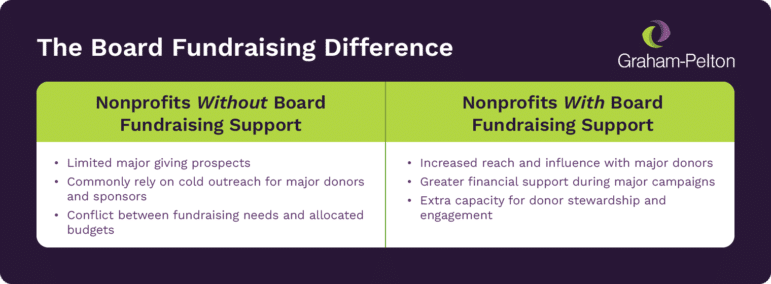
When nonprofit fundraisers have backing from their boards, they tend to:
- Source more major giving prospects
- Launch more organized and successful capital campaigns
- Improve and maintain donor relationships at increased capacity
Additionally, when board members participate in fundraising activities, they tend to gain a better understanding of the day-to-day work that goes into financing your organization. As a result, they’ll bring valuable insights to board discussions about fundraising budgets, oversight, and long-term strategic direction.
What Role Do Boards Play in Fundraising?
Whether your board members take a hands-on approach to fundraisers or remain fairly distant from campaign activities, they will always significantly influence your nonprofit’s fundraising efforts. Specifically, boards can:
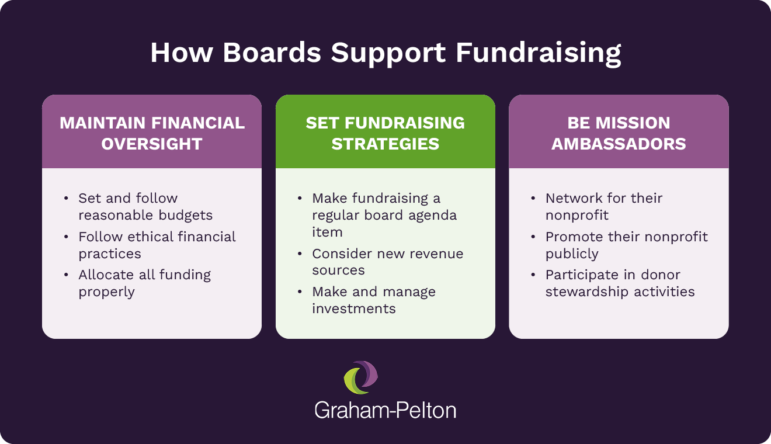
Maintain financial oversight.
While your nonprofit’s bookkeeper and accountant will manage your nonprofit’s finances, it’s up to boards to ensure that their nonprofits:
- Set and follow reasonable budgets. With the information your nonprofit’s financial team, executive director, and fundraising director present to your board, you should set a budget that appropriately covers all needs and maintains your organization’s financial stability. Ensure your board’s treasurer is an expert on your nonprofit’s finances and is able to relay complex financial information to the rest of your board.
- Follow ethical financial practices. Fundraising ethics include: implementing processes that prevent fraud, maintaining financial records necessary for legal compliance, and being aware of potential financial risks. For instance, it would not be considered unethical if a nonprofit’s endowment has investments that fail to earn dividends, but it may be considered unethical if a nonprofit deliberately makes risky investments.
- Allocate all funding properly. Boards must ensure that their nonprofits adhere to their budgets and respect any legal or donor-imposed limitations on funding. In particular, boards should be knowledgeable about the differences between restricted and unrestricted funding. Then, they should use this knowledge to ensure restricted gift spending follows donors’ stipulations while also helping their nonprofit secure gifts that fund their organization’s priority areas.
Additionally, boards are often tasked with approving major spending decisions, such as allocating a budget for a capital campaign or agreeing to a fundraising consultant’s retainer fee.
Set long-term fundraising strategies.
Successful nonprofits have boards and fundraising teams that work hand in hand to set and reach fundraising goals. A few ways boards can set and support long-term fundraising strategies include:
- Making fundraising a regular board agenda item. By regularly discussing fundraising in board meetings, you can ensure your campaigns align with your fundraising priorities and that your long-term strategy continues to serve your nonprofit’s needs.
- Considering new revenue sources. There’s a wide variety of fundraising channels, and boards should direct financial teams on which ones to pursue. This might involve seeking out more corporate sponsorships, applying for grants, or building a planned giving program.
- Making and managing investments. While fundraising teams can suggest investment opportunities, it’s up to the board to approve and allocate funding to major investment activities, such as starting an endowment fund.
Boards are also responsible for making potentially long-term spending decisions related to internal financial management, like setting executive compensation packages. As such, boards must have a strong sense of their nonprofit’s current financial situation and future projections. This insight ensures all investments—whether in financial markets, staff, and campaigns—are appropriate.
Be mission ambassadors.
Through their time and major gifts, board members already invest in their nonprofits. As such, they can and should be some of their nonprofits’ biggest champions. This means being a mission ambassador.
A mission ambassador is essentially a representative of a nonprofit who actively represents its mission and advocates for its cause. This usually involves:
- Networking for your nonprofit. Many nonprofit board members are major community figures and thus have connections and are invited to networking events. If this applies to you, you can network for your nonprofit by discussing your organization’s story, sharing your own reasons for support, and speaking about the power of philanthropy.
- Promoting your nonprofit publicly. Outside of organized networking events, board members can positively represent their nonprofit in other aspects of their lives. For example, you might use social media to promote your nonprofit’s latest fundraiser or discuss the impact it’s having in your community.
- Participating in donor stewardship activities. Even if you’re hesitant to make fundraising asks, you can still be a helpful mission ambassador by assisting with day-to-day stewardship activities that lead up to the next fundraising ask. For example, you might create handwritten thank-you notes to donors or attend fundraising events, like galas, to socialize with major giving candidates.
Even when not actively acting as a mission ambassador, remember that as long as you are a board member, you always represent your nonprofit.

Board Fundraising Best Practices
1. Don’t be afraid to seek outside help.
Even if your board already has fundraising experience, a fundraising consultant can provide invaluable industry insights and a third-party perspective on your current operations. Specifically, a fundraising consultant can help by:
- Reviewing current practices. Fundraising consultants can provide an objective assessment of your current fundraising campaigns, long-term strategic plan, and overall day-to-day fundraising operations. Find a consultant who regularly works with nonprofits similar to yours in terms of size, budget, and sector to get targeted advice.
- Suggesting new strategies. After their initial assessment, consultants will make recommendations for how you can improve your fundraising strategy. For boards, they might suggest specific ways that board members can support fundraising or even get involved in a campaign.
- Guiding campaigns. For complex and large-scale campaigns, such as a capital campaign, a fundraising consultant can become part of your team. How hands-on a fundraising consultant is varies from agency to agency, meaning you can find consulting models that range from simply offering advice to consultants who participate in fundraising activities alongside your team.
Fundraising consultants are experts in campaign management and strategy. This means that if your board has any questions about a fundraiser—such as what an appropriate budget is, what ROI the nonprofit should expect, or what specific fundraising data means—a consultant can provide answers.
2. Make fundraising a leadership priority.
Some nonprofits may have boards that primarily focus on mission direction, internal operation strategies, and other important aspects of their organization outside of fundraising. While boards should still discuss these key points during board meetings, fundraising should always be a priority, as well.
Boards and other nonprofit leaders set the tone for the rest of your organization. By ensuring that your board understands your nonprofit’s current fundraising strategy and actively supports it, you can create a culture committed to informed, consistent fundraising progress.
Along with discussing fundraising in board meetings, individual board members show their dedication to fundraising by actively participating in ongoing campaigns. After all, when staff, volunteers, and donors see board members going out of their way to join a fundraiser, they’ll feel supported by leadership and understand that your nonprofit’s decision-makers are committed to their fundraising success.
3. Set clear board expectations.
Allowing each individual board member to decide how they will support fundraising provides both freedom and a lack of direction. Without clear expectations, some board members will go the extra mile, while others might assume they’re already supporting fundraising by participating in board meetings that include it as an agenda item.
When discussing board involvement in fundraising, be clear about:
- Specific ways board members can participate in fundraising. Do not leave “support our fundraisers” as a vague idea. Instead, provide examples of specific actions board members can take, such as meeting with major donors, presenting your nonprofit at an event, and signing fundraising thank-you cards.
- How often and to what extent board members are expected to participate. While you likely won’t provide an exact dollar amount that board members are expected to donate or a specific number of hours that they should volunteer, be clear about the expected level of participation. For example, during a capital campaign, there may be an expectation that each board member will help source major-giving prospects and meet with at least a few major donors.
- What fundraising resources are available to board members. Board members with little fundraising experience may assume they will be more of a burden than an asset. Support your board’s efforts to get involved in fundraising by pointing them toward training resources, fundraising tools, and members of your fundraising team who can provide guidance.
The relationship between a nonprofit’s board members and fundraising team should be collaborative. Expectations should help board members better understand their role in the fundraising process, rather than feeling like strict directions are being enforced on them. Hold open conversations about board fundraising opportunities to address expectations and workshop exact guidelines based on both groups’ feedback.
4. Engage in donor stewardship.
The primary way many board members support their organization’s fundraisers is through stewarding donors. This serves two primary purposes:
- Board members often have connections to major giving prospects. Many board members are major donors themselves, meaning they likely know other individuals in their orbit who also have the capacity and affinity to become major donors. By facilitating introductions, board members can provide their nonprofits with warm initial contact with valuable giving prospects.
- Many board members are hesitant to make fundraising asks. Making the donation request is often the most difficult part of fundraising, and many board members avoid participating in fundraisers specifically because they fear having to ask others for money. Nonprofits can avoid this by getting their board members involved with every part of the donor lifecycle except for the actual fundraising ask.
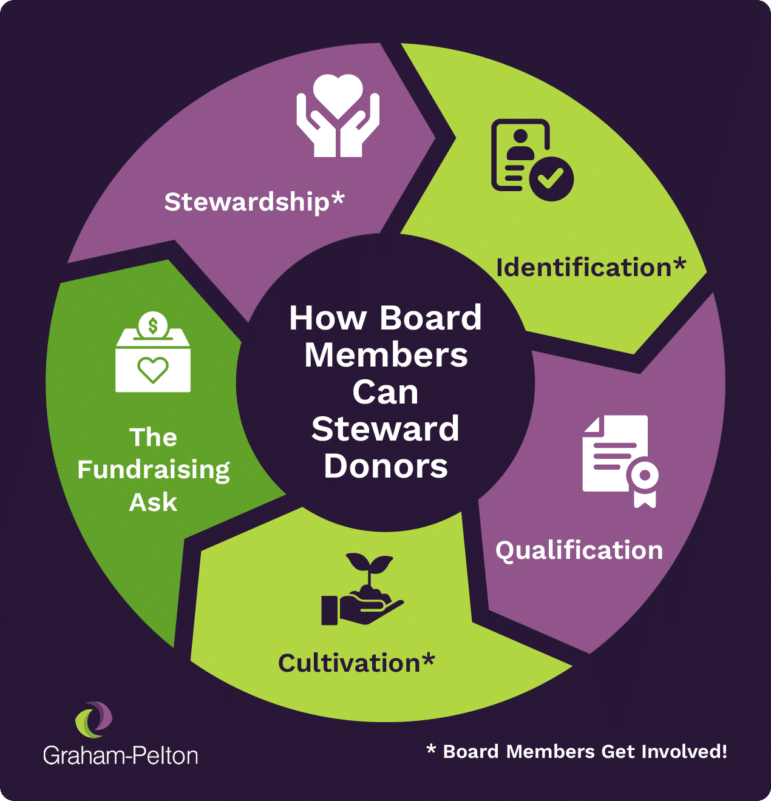
“Donor engagement” is also a broad term that gives board members many options for how they might use their specific strengths to get involved.
5. Understand each board member’s unique strengths.
Every board member brings something unique to the table, and nonprofits should capitalize on their unique skills. Each board member should consider their strengths, and fundraising teams can present a list of opportunities to help board members self-select for engagement opportunities that align with their skill sets.
For example, here are a few useful abilities that board members may have and the associated fundraising activities:
- Public speaking skills: Hosting presentations, making speeches at events, and representing the nonprofit at conferences
- Networking: Meeting with donors one-on-one, attending events to socialize with donors, and participating in introductions between the nonprofit and prospective donors
- Organization and management skills: Assist with event planning, help coordinate donor outreach activities, and lead oversight responsibilities
Nonprofits can also help interested board members access training opportunities to expand their current skill sets and take on new fundraising responsibilities. For example, a board member who regularly gives speeches at your events may be interested in helping organize the events, as well.
6. Keep organizational needs in mind.
Board members are often instrumental in securing major gifts. However, as many major gifts have specific restrictions, there can be tension between the nonprofit’s immediate priorities and the donors’ ambitions.
This can lead to situations where board members pursue large-dollar major gifts due to the sheer quantity of the promised donation, but the donor’s restrictions prohibit the gift from funding the nonprofit’s core needs.
When board members get involved in the major donor stewardship process, they should stay informed about their nonprofit’s needs and core missions. In particular, board members can support their nonprofits by championing unrestricted gifts, which provide their nonprofits with far greater flexibility.
7. Embrace new fundraising tools and frameworks.
As board members get involved in fundraising, they should become acquainted with their nonprofit’s fundraising tools, strategies, and processes. A few types of resources a nonprofit fundraising team might share with its board include:
- Outreach style guide to ensure all communications are aligned with the nonprofit’s brand
- Major gift profiles to provide board members involved in the stewardship process with information about the candidates they engage with, as well as the ability to add notes from their meetings to a centralized system
- Fundraising framework guidelines that enable board members to approach prospective donors with the nonprofit’s proven fundraising communication style in mind
The exact frameworks your nonprofit uses will depend on your fundraising programs and organization type. For example, a healthcare organization with a grateful patient program might have strict guardrails on how fundraising development officers speak to current and former patients.
Additional Fundraising Resources
Board members can be some of their nonprofit’s most valuable fundraisers. To start improving your fundraising potential, make fundraising a board priority and set up partnerships with your fundraising team so board members can find roles where they’ll thrive.
For additional fundraising resources, explore these comprehensive guides:
- How to Write a Case for Support: Pro Tips for Driving Impact. A case for support is essential for securing revenue from top supporters. Learn how to create one that drives donations.
- Healthcare Fundraising: Overview & 15 Modern Strategies. Healthcare organizations have unique fundraising requirements that board members should be aware of. Discover strategies for successful fundraisers that fit your hospital or healthcare organization’s needs.
- University Fundraising 101: Trends, Analysis, & Strategies. University boards play a key role in connecting with major donors, making investment decisions, and more. Brush up on university fundraising fundamentals to guide your organization with confidence.