How to Conduct a Feasibility Study: Each Step Explained


Feasibility studies are a key step in planning most successful capital campaigns. However, given that many consultants conduct feasibility studies on behalf of nonprofits with varying degrees of input from the organizations that hire them, it is normal to be curious about what actually happens behind the scenes during these studies.
To help your nonprofit better understand what happens during a feasibility study, why they matter, and how your organization can take a more hands-on role during this process, this guide will break down the five core steps of a capital campaign feasibility study.
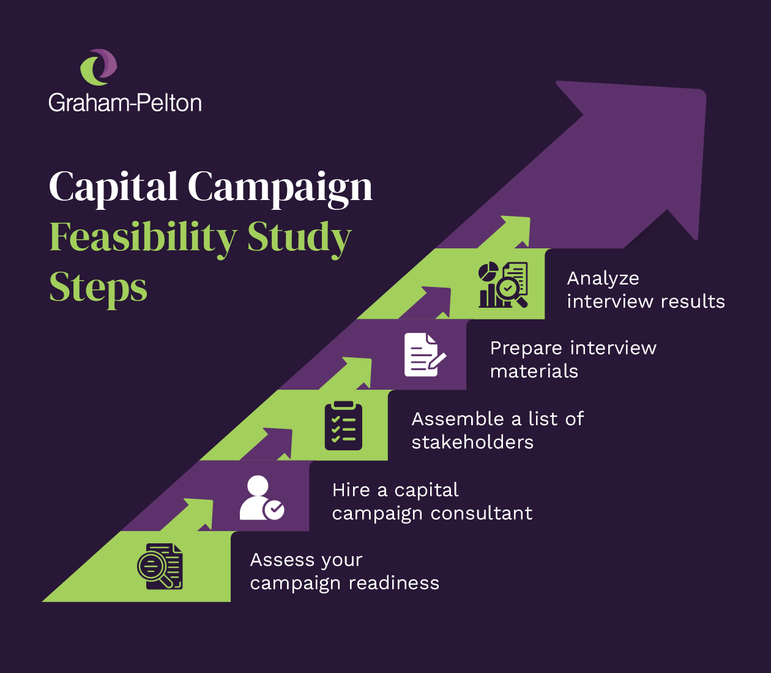
1. Assess your nonprofit’s current campaign readiness.
Pre-campaign readiness is key to undertaking a multi-year, fundraising-intensive capital campaign. To ensure nonprofits are prepared for this process, some consultants even advise organizations to assess their general readiness before even conducting the feasibility study.
While consultants can provide their unbiased and experienced perspective to fully evaluate your nonprofit’s readiness, there are several actions your nonprofit can take before even getting in touch with a consultant. These include:
- Determining your campaign project. Your case for support will be fleshed out later, but at this stage, you should know generally what you want your campaign to fund. For example, you may have a building project in mind or need an infusion of funds to expand your services to a new location. Ensure you have a large-scale project in mind that necessitates a capital campaign, rather than simply looking to increase funding.
- Assessing your resources. Since you likely don’t have a clear fundraising goal yet, you won’t be able to nail down a budget at this stage. However, you should assess what resources—including cash on-hand, staff time, and technology—you have available that can be devoted to your campaign. For example, you will need to be able to cover the cost of the feasibility study itself.
- Getting board approval. Ultimately, your board has final say in whether you pursue a capital campaign. Some boards are more involved in fundraising than others, and you may need to educate your board on what a capital campaign is and what their expected role in it will be. At the very least, your board will need to approve your request to hire a capital campaign consultant, which requires pitching the value of feasibility studies, professional campaign management, and partnering with an external expert.
Your consultant may build on this early ground work both before and after the feasibility study. For example, if the consultant thinks your campaign should aim higher based on stakeholder conversations or suggests a new budget projection based on the scale of your project, they can help pitch your campaign’s new direction to your board.
However, even if the work you do at this stage ends up being re-done by your consultant later, it is still valuable. Going through these steps will allow you to have more productive conversations with your consultant about the shape of your campaign, as well as help your nonprofit determine if hiring a consultant is even the right next step. For example, you may realize you lack a strong reason to launch a campaign, or your board may simply reject the idea of a capital campaign or hiring a consulting firm, meaning you will need to do more work to prepare your next pitch.
2. Hire a capital campaign consultant.
With the confirmation that your nonprofit wants to conduct a feasibility study or at least get a consultant’s advice on whether you’re ready for a feasibility study, it is time to start researching consultants.
To hire your capital campaign consultant, follow these steps:
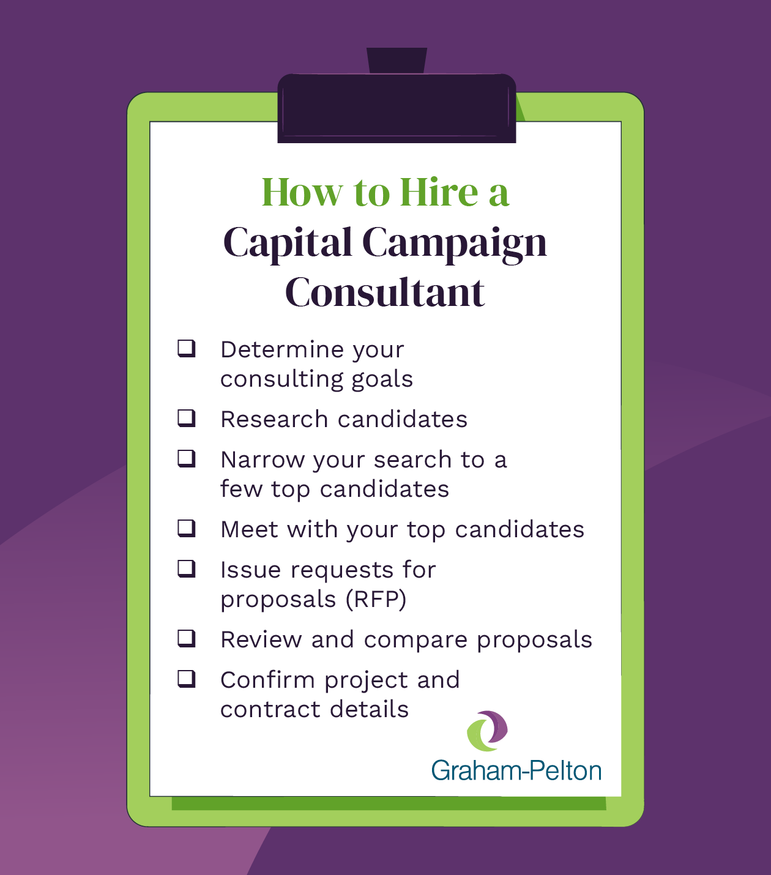
- Determine your consulting goals. Having a goal for your consultant will help direct your partnership, allowing them to pitch solutions rather than guess what your nonprofit needs. Additionally, clear goals cement internal alignment, ensuring everyone involved in the hiring process understands why you need a consultant.
- Research candidates. There are hundreds of professional capital campaign consultants who specialize in all types of nonprofits and campaign models. Basic online searches can help you find recommended providers, and many nonprofits reach out to their peers at other organizations to ask for recommendations.
- Narrow your search to a few top candidates. For each consultant, explore their services before reaching out. Ensure they regularly work with nonprofits like yours, have the types of services you need, and are highly recommended. If you would like a local consultant, consider location as well. Aim to narrow your list to around four or five consultants to avoid spending excessive time in the later hiring stages.
- Meet with your top candidates. Reach out to your top consultants to arrange interviews, whether in-person or online. Use these meetings to introduce your nonprofit, explain your campaign, and share what you hope to accomplish by working with a consultant. This is also an opportunity to ask the consultant questions about the types of campaigns they usually work on and what their methodology is. Assess their answers to determine if their approach aligns with your nonprofit’s goals and work culture.
- Issue requests for proposals (RFPs). Invite your top consultants to complete an RFP. This is their opportunity to think more deeply about your project and provide detailed plans for what solution they would implement. Take note that some consultants prefer not to complete RFPs and prefer only interviews. It is up to your nonprofit whether to continue considering these consultants or only move forward with candidates willing to complete an RFP.
- Review and compare proposals. Form a committee to review and rank the proposals. To structure your review process, create a rubric to score each proposal. Typical criteria include how well the proposal addresses your nonprofit’s needs, your overall impression of the consultant’s approach and methodology, and how well each proposal fits your nonprofit’s budget. Weight these criteria to ensure the most important categories are properly reflected in your scoring. For example, a consultant might have a strong solution but their methodology involves acting in only an advisory capacity, when your nonprofit needs more hands-on help.
- Confirm project and contract details. Once you’ve selected your consultant, meet with them to discuss their proposal, ask any remaining questions, and review the partnership contract. This is also your last opportunity to assess how well they get along with your team. Remember, an ideal capital campaign consultant will work with your nonprofit for several years, which means compatibility is essential.
While nonprofits can hire separate consultants to complete their feasibility study and manage the actual campaign, the consultant who completes your feasibility study will have a strong understanding of your nonprofit and campaign. As a result, your feasibility study consultant can likely jump straight into helping manage your campaign if the study results indicate you’re ready to get started.
3. Assemble a list of stakeholders to meet with.
Work with your consultant to compose a list of all the people they should meet with to discuss your campaign. These stakeholders should include:
- Major donors. The majority of feasibility study interviews will likely be held with your major donors. These individuals have invested in your nonprofit in the past and may be inspired to give again, so attaining their buy-in is essential for hitting your campaign target. Create a list of your current major donors, prospective major donors, grateful patient donors, planned donors, business sponsors, and anyone else you think may be interested in and capable of making a major contribution to your campaign.
- Community leaders. To assess the feasibility and potential value of your project, consultants may interview community leaders who can speak on behalf of the individuals who will be impacted by your project. These interviews can help them learn if there is an active demand for your project, how well your current proposal suits their needs, and if there are specific elements of your project it would make sense to elevate or drop. For example, a homeless shelter may be interested in purchasing and renovating the building next door to expand its services, but interviews with impacted individuals reveal they would actually benefit more if a shelter opened a new location in a neighboring town.
- Internal staff. By speaking with donors and community members, consultants can determine your campaign’s fundraising potential and project value. Then, by speaking with your nonprofit’s team, they can learn about your current capacity to actually carry out your fundraiser and project. Consultants might speak with board members, leadership, or even a few development officers to assess your nonprofit’s overall fundraising capabilities and processes.
Your consultant will help you create your list of interviewees. For example, you may analyze your donor database and conduct prospect research with your consultant’s guidance to find more major giving candidates who they can speak to. Or, your consultant might attempt to source more interview subjects by asking various stakeholders they meet with if they have any recommendations for who the consultant should reach out to.
Consultants will also set up these interviews themselves. Your nonprofit will provide stakeholders’ contact information, and the consultant will email them to set up meetings, conduct phone interviews, and otherwise get in touch to speak about your campaign.
4. Prepare interview materials.
Strong interview questions provide your nonprofit with targeted feedback to help improve your campaign materials while also assessing your community’s overall giving capacity and interest. Collaborate with your consultant to prepare for these interviews by:
- Putting together a case for support. Before talking to stakeholders, ensure your nonprofit has a working case for support that explains your project, the problem it is trying to solve, and why your project will be impactful. At this stage, you’re not asking donors for support, but rather sourcing feedback on whether your case for support makes a compelling argument for your campaign.
- Creating interview questions. Prepare questions to guide the interview. This might include specific questions about your case for support—such as whether they feel the vision is inspiring or achievable—if they have any concerns about your campaign, and what level of support they could see themselves giving your campaign.
- Providing background on stakeholders. Where possible, provide your consultant with details about each stakeholder they plan to meet with. When your consultant understands each interviewee’s relationship with your nonprofit, they can better uncover their motivations for giving, interest in your campaign, and potential for providing support.
In addition to individual interviews, consultants also often send out digital surveys. This allows them to gather even more feedback from stakeholders who may be unable to attend an in-person meeting or individuals who may have useful insights but aren’t necessary to speak with one-on-one. For instance, rather than meeting with every member of your fundraising team, your consultant may interview your development director and send surveys to the rest of your staff.
As such, your consultant may also create a standardized interview survey to send to other stakeholders. These will likely include a mix of question types, including open-ended questions that invite interviewees to provide detailed feedback.
5. Analyze interview results.
Rarely do nonprofits receive a simple yes or no about whether their campaign is feasible after wrapping up interviews. Instead, your consultant will analyze the results to identify trends in feedback and provide recommended next steps.
Usually, feasibility study results exist on a spectrum:
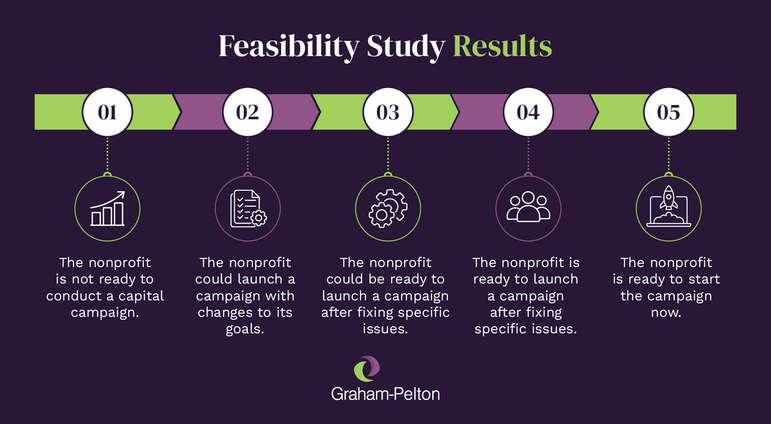
- The nonprofit is not ready to conduct a capital campaign. If a consultant determines that your nonprofit is not ready to launch a capital campaign, they will outline their reasoning and the steps your nonprofit can take to prepare. Usually, nonprofits only receive the response that their campaign is not feasible if they have underlying problems that will likely take time to resolve. For example, if your nonprofit lacks any formal major donor program, a consultant may suggest taking a year to formalize that process and grow your donor base before re-evaluating your campaign.
- The nonprofit could launch a campaign with changes to its goals. Your consultant may find that your nonprofit has the capacity and donor support to launch a capital campaign but will need to scale back your original plans. This may be disappointing but it can save your nonprofit from finding itself stuck several years in chasing an impossible goal.
- The nonprofit could be ready to launch a campaign after fixing specific issues. Similar to the first approach, the consultant identifies significant issues that must be fixed before the campaign launches but a campaign is still possible after doing so. For example, a nonprofit that lacks board alignment will need to get over that obstacle before getting started but could theoretically do so with a strong pitch meeting.
- The nonprofit is ready to launch a campaign and can address remaining issues during planning. The consultant identifies potential issues that can be addressed during the campaign planning phase. For example, your fundraising team may need additional training that the consultant could conduct before the first donor meetings and provide continued coaching throughout the campaign.
- The nonprofit is ready to start the campaign now. For experienced nonprofits, consultants may even recommend an accelerated feasibility study. With this approach, nonprofits will jump straight into the campaign planning immediately after—or potentially even during—the feasibility study.
If you have questions about your consultant’s recommendations, ask them. The results of your feasibility study should be a conversation about how your nonprofit can move forward, rather than an end-all statement about your campaign prospects.
Complete Your Feasibility Study with Graham-Pelton
If you’re looking for a consultant to conduct your feasibility study and guide your campaign, partner with Graham-Pelton. Our planning studies provide a comprehensive, in-depth view of your nonprofit to create a focused plan for how your nonprofit can move forward with its campaign.
We offer two types of feasibility and planning studies:
- Campaign Confidence Study: For nonprofits still testing priorities and deciding whether to launch a campaign, our traditional feasibility and planning study provides a thorough analysis of your donor readiness and giving capacity, while also outlining a roadmap for how to navigate every phase of your campaign.
- Campaign Accelerated Planning System (CAPS™): For nonprofits that have conducted campaigns before, have committed leadership, urgent project needs, and a highly engaged donor base, CAPS™ combines the planning study with early campaign execution and strategic campaign management, so your campaign keeps its momentum from planning through launch.
To learn more about our feasibility study services and learn which is right for your nonprofit, please reach out to our team at Graham-Pelton.
More Capital Campaign Planning Resources
A feasibility study lays the foundation for your campaign. Ensure you make the most of this crucial step by working with an expert consultant who can analyze your donor base, conduct insightful interviews, and provide targeted recommendations.
For more tips to improve your fundraising strategy ahead of your campaign, explore these top resources:
- 9 Key Types of Planned Gifts, How They Work, and Examples. Planned gifts can be a key source of funding for your campaign. Learn about the types of planned giving and how to create a planned giving program.
- Healthcare Fundraising: Overview & 15+ Modern Strategies. Healthcare organizations have unique campaign challenges and opportunities. Discover strategies for improving your healthcare organization’s fundraising processes.
- Your Guide to Mastering Predictive Analytics for Fundraising. Predictive analytics can help forecast your campaign outcomes. Explore predictive analytics use cases, and discover how you can start analyzing your data.